

Aspheric Microlenses
-
Molded glass aspheric microlenses
-
Corrected for use with laser diodes
-
Diffraction limited performance
-
Mounting flanges built in
These aspheric lenses are manufactured by precision molding of optical crown glass. Aspheric surfaces permit a higher degree of correction than spherical surfaces thereby providing for improved performance out of a simple, single element lens. This range of microlenses have been corrected for use with a standard laser diode window and are primarily intended for the collection and collimation of laser diode radiation. They have diffraction limited performance at any wavelength in the laser diode spectrum and can be Anti-Reflection coated upon request. Since the lenses have been molded a mounting flange has been built in to the lens removing the need for costly and inconvenient mounting cells. A range of numerical apertures are offered and this should be selected according to the application.
Biconcave Microlenses
-
Microlenses for a variety of demanding miniaturization applications
-
Diameters down to 0.06 inches, focal lengths to less than 2mm
-
Plano convex, plano concave, biconvex and biconcave lens shapes available as standard
-
Precision polished to λ/2 surface figures
-
Ideal for coupling fibers and laser diodes to each other or to systems
-
Mounting of microlenses in aluminum housings available
These very small lenses are made from high index optical glass. They are precision polished to very high tolerances so that they can be mounted into complex imaging systems. These lenses are supplied uncoated.
Biconvex Microlenses
-
Microlenses for a variety of demanding miniaturization applications
-
Diameters down to 0.06 inches, focal lengths to less than 2mm
-
Plano convex, plano concave, biconvex and biconcave lens shapes available as standard
-
Precision polished to λ/2 surface figures
-
Ideal for coupling fibers and laser diodes to each other or to systems
-
Mounting of microlenses in aluminum housings available
These very small lenses are made from high index optical glass. They are precision polished to very high tolerances so that they can be mounted into complex imaging systems. These lenses are supplied uncoated.
Gradient Index Convex Microlenses
-
Cylindrical shape is easy to mount, easy to align
-
Available with both plano and convex end profiles
-
Available for popular visible and IR laser wavelengths
-
Perfect solution for optical data transmission applications
-
Also available with the focal plane falling outside the lens for non-contact use
Optical glass with a refractive index gradient provides a very efficient and simple way to produce high quality imaging lenses. The material used in these microlenses is Selfoc®. This material has a radial index gradient which causes focusing to occur within the material. The index variation is defined by and is normally specified by the constant √ A. The simplest form of gradient index lens is a simple cylinder of Selfoc®. Collimated light incident on one end of the lens will be focused as it travels along the length of the cylinder. These microlenses are particularly useful for fiber and diode coupling since they can be mounted in close proximity to the source. They are ideal for use in optical data transmission. We offer gradient index microlenses with plano end faces and also in a convex configuration for greater imaging power. The convex lenses have a spherical radius on one end only.
Normally these lenses are a quarter pitch so that they focus a collimated input at the remote face of the lens. However, we also offer lenses having slightly less than 1/4 pitch so that they focus just outside the lens. This is often more convenient since contact with the source or detector may be physically impossible. Two different numerical apertures are offered, 0.46 and 0.6. These lenses are wavelength specific. They are supplied for the wavelengths 633, 830, 1300 and 1560 nm and are Anti-Reflection coated for these wavelengths. They will work at other wavelengths but their focusing characteristics will vary from the published figures and the coatings will not be optimized.
Gradient Index Imaging Microlenses
-
Available in diameters from 0.25 to 1.0mm
-
Magnifications from 5 to 20X
-
High resolution performance,
-
200 line-pairs per mm
These gradient index microlenses are optimized for imaging applications. They form an image at one face of the lens of an object at a working distance of 5mm from the opposite face of the lens. This image may be viewed directly by a 100X microscope or transferred to the distal end of a coherent fiber bundle or gradient index relay lens. The lenses are supplied uncoated and no coatings are offered.
Gradient Index Plano Microlenses
-
Cylindrical shape is easy to mount, easy to align
-
Available with both plano and convex end profiles
-
Available for popular visible and IR laser wavelengths
-
Perfect solution for optical data transmission applications
-
Also available with the focal plane falling outside the lens for non-contact use
Optical glass with a refractive index gradient provides a very efficient and simple way to produce high quality imaging lenses. The material used in these microlenses is Selfoc®. This material has a radial index gradient which causes focusing to occur within the material. The index variation is defined by and is normally specified by the constant √ A. The simplest form of gradient index lens is a simple cylinder of Selfoc®. Collimated light incident on one end of the lens will be focused as it travels along the length of the cylinder. These microlenses are particularly useful for fiber and diode coupling since they can be mounted in close proximity to the source. They are ideal for use in optical data transmission. We offer gradient index microlenses with plano end faces and also in a convex configuration for greater imaging power. The convex lenses have a spherical radius on one end only.
Normally these lenses are a quarter pitch so that they focus a collimated input at the remote face of the lens. However, we also offer lenses having slightly less than 1/4 pitch so that they focus just outside the lens. This is often more convenient since contact with the source or detector may be physically impossible. Two different numerical apertures are offered, 0.46 and 0.6. These lenses are wavelength specific. They are supplied for the wavelengths 633, 830, 1300 and 1560 nm and are Anti-Reflection coated for these wavelengths. They will work at other wavelengths but their focusing characteristics will vary from the published figures and the coatings will not be optimized.
Gradient Index Relay Microlenses
These microlenses are formed from gradient index glass as rods whose length is equal to an integral number of pitches. In this way an image formed on one end of the lens is transferred to the remote end from where it may be viewed or transferred to another medium.
These are used in rigid endoscopes and other applications which require the transfer of images. They are ideal for use with the gradient index imaging microlenses described previously.
Micro Prisms
Our right angle micro prisms are available in sizes from 1.0 to 5.0mm. The uncoated prism will act as a mirror for light incident on one of the short sides (legs) since incident light is totally internally reflected at the hypotenuse (TIR). They are provided standard in BK7 with other sizes and material available upon request.
Microspheres
-
Ideal for coupling optical fibers to laser diodes and detectors
-
λ/4 surface figure for high performance
-
Single layer MgF2 coated for visible or infrared uses - uncoated also available
-
Coating axis is identified for ease of mounting
-
Focal lengths from 1 to 3mm - diameters from 2 to 5mm
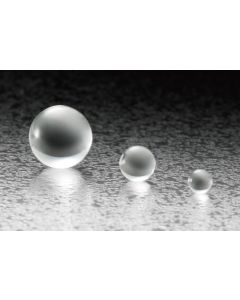
Microspheres are convenient for coupling light into or out of fibers as well as for relaying images in compact areas. The focal point of a sphere is very close to its surface so the sphere can be placed in contact with the fiber or another sphere for almost perfect coupling. Three different coatings are available. All are single layer MgF2 coatings which have been optimized for the visible range or either of the two diode laser bands. If a coated microsphere is chosen it will be necessary to maintain the coating axis when in use. This axis is marked with a removable black dot for ease of location.
Plano Concave Microlenses
-
Microlenses for a variety of demanding miniaturization applications
-
Diameters down to 0.06 inches, focal lengths to less than 2mm
-
Plano convex, plano concave, biconvex and biconcave lens shapes available as standard
-
Precision polished to λ/2 surface figures
-
Ideal for coupling fibers and laser diodes to each other or to systems
-
Mounting of microlenses in aluminum housings available
These very small lenses are made from high index optical glass. They are precision polished to very high tolerances so that they can be mounted into complex imaging systems. These lenses are supplied uncoated.
Plano Convex Microlenses
-
Microlenses for a variety of demanding miniaturization applications
-
Diameters down to 0.06 inches, focal lengths to less than 2mm
-
Plano convex, plano concave, biconvex and biconcave lens shapes available as standard
-
Precision polished to λ/2 surface figures
-
Ideal for coupling fibers and laser diodes to each other or to systems
-
Mounting of microlenses in aluminum housings available
These very small lenses are made from high index optical glass. They are precision polished to very high tolerances so that they can be mounted into complex imaging systems. These lenses are supplied uncoated.